Account Questions
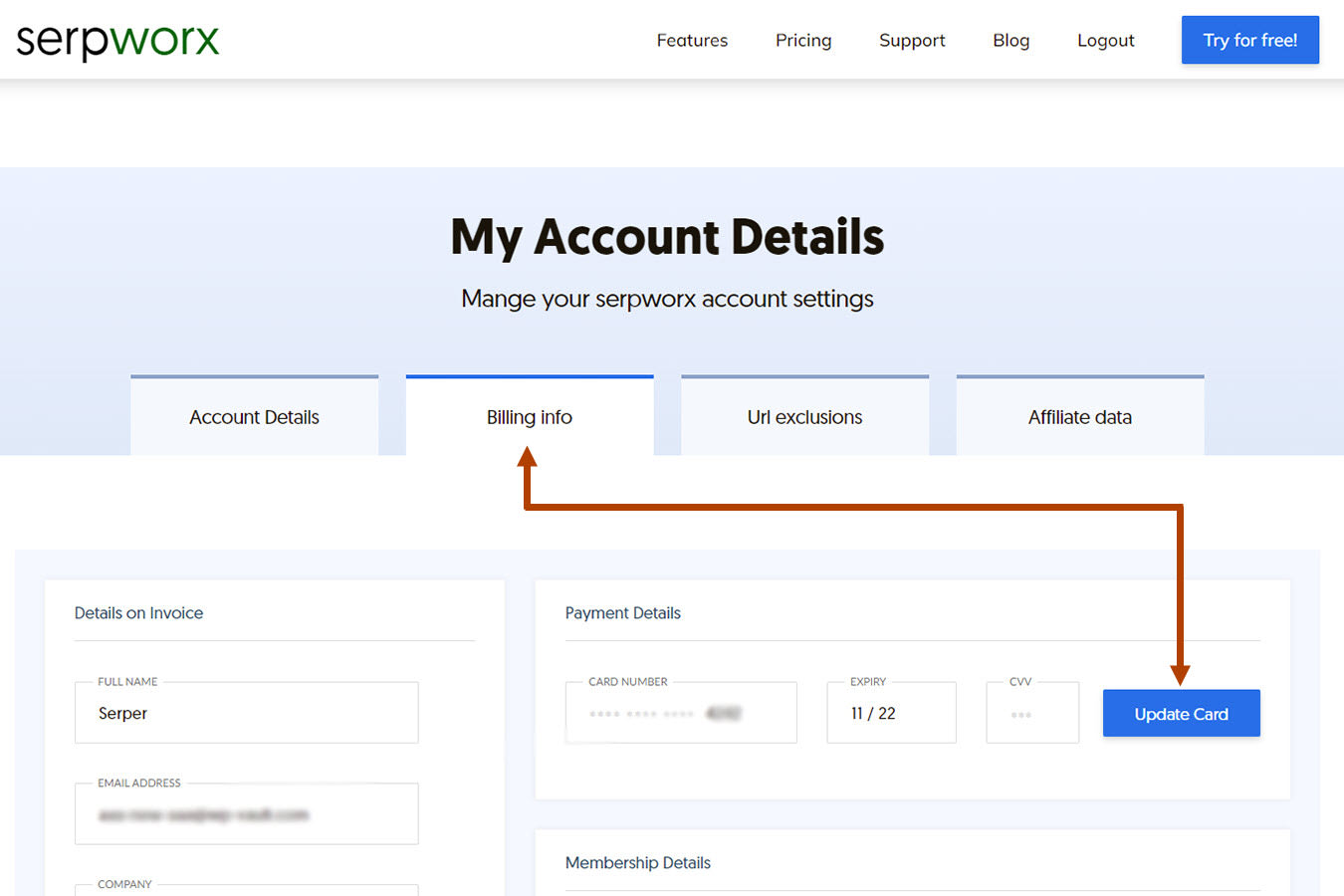
You can easily update your credit card details on your account page here . Just click on the 'Update payment details' button as per this screenshot
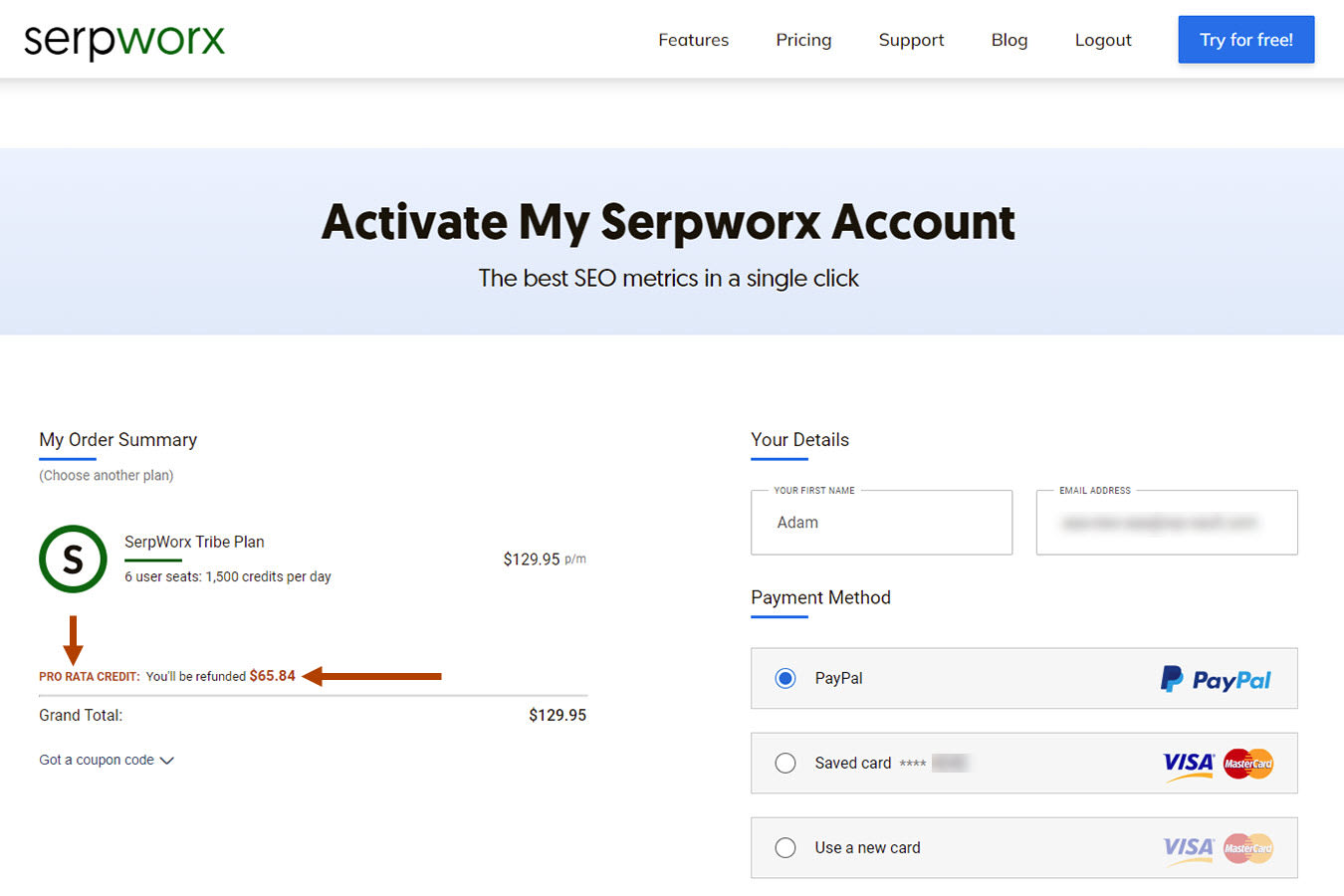
If you need to change your actual payment type (ie from PayPal to credit card or vice versa), then you will automatically be issued a pro rata refund as per this screenshot
You will not lose any search credits or pay any extra to swap your subscription from Credit Card to PayPal or vice versa. (unless you choose an upgraded plan)
Here's a quick video on how to log into the extension. All of the following use exactly the same username and password:
- The SerpWorx Chrome extension
- This SerpWorx website
- The SerpWorx support portal
If you can't login or have forgotten your password, the easiest way to reset it is via the password reset link in the footer: https://www.serpworx.com/forgot-password/
If you would like further help, firstly check our live chat window on the bottom right-hand corner - if that is not open then just open a support ticket here.
All plans operate off daily credits. 1 credit = the SEO metrics for 1 site.
All plans include all features. The only difference between any plan is the amount of daily credits. Multi-user plans allow simultaneous usage and single user account types don't.
You can install the SerpWorx extension on as many computers as you like. That way you can use it on any computer you have access to.
You can use the following link to reset your password: https://www.serpworx.com/forgot-password/
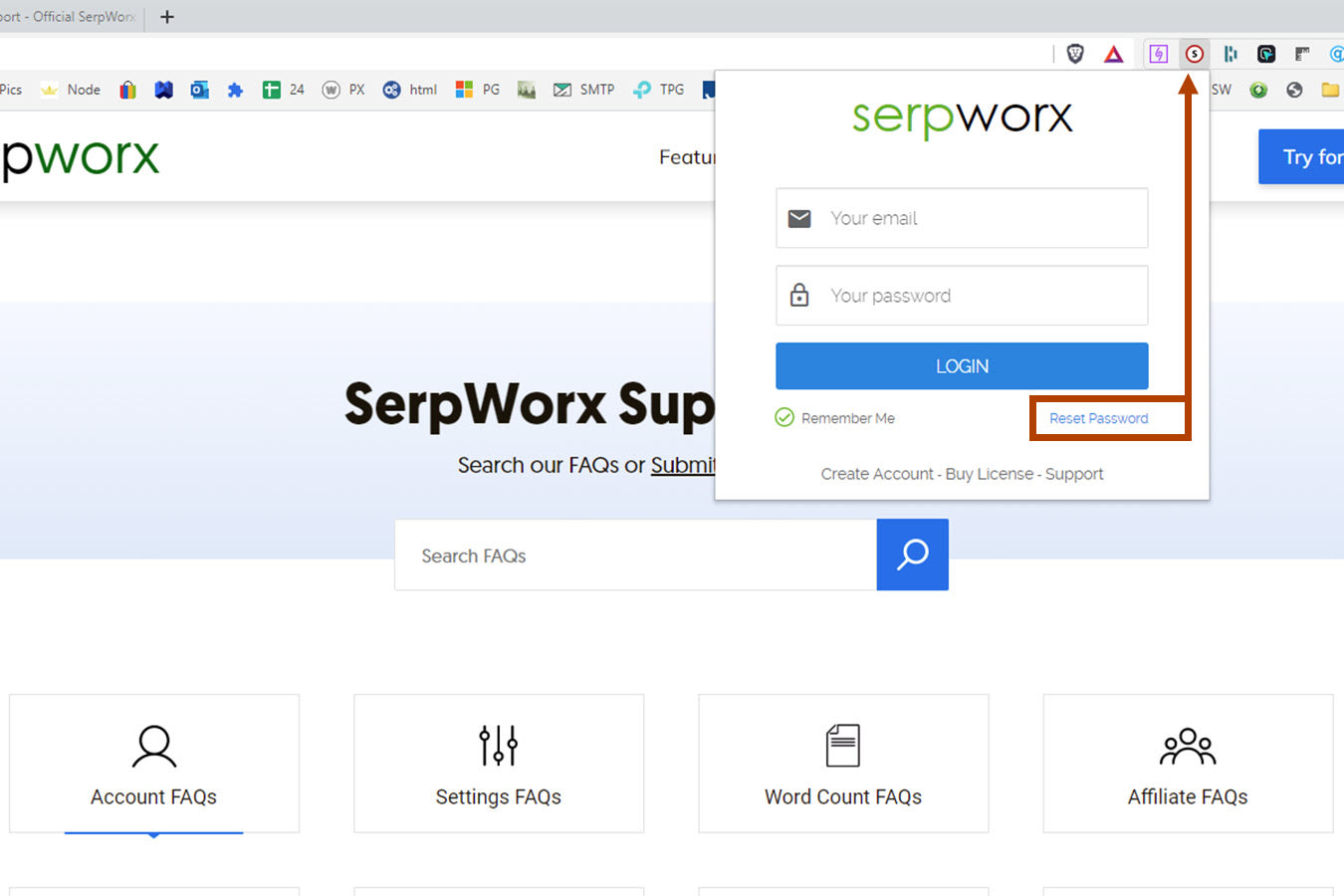
You can also reset your password from within the SerpWorx Chrome extension itself as per this screenshot
Settings Questions
There are only a couple of critical settings in SerpWorx to ensure you enjoy the best user experience possible. These options are all best explained In this short settings video
We stop SerpWorx from showing on a massive range of URLs like /wp-admin/ etc. However, it's impossible for us to know all the URLs you don't want the SerpWorx toolbar to show on.
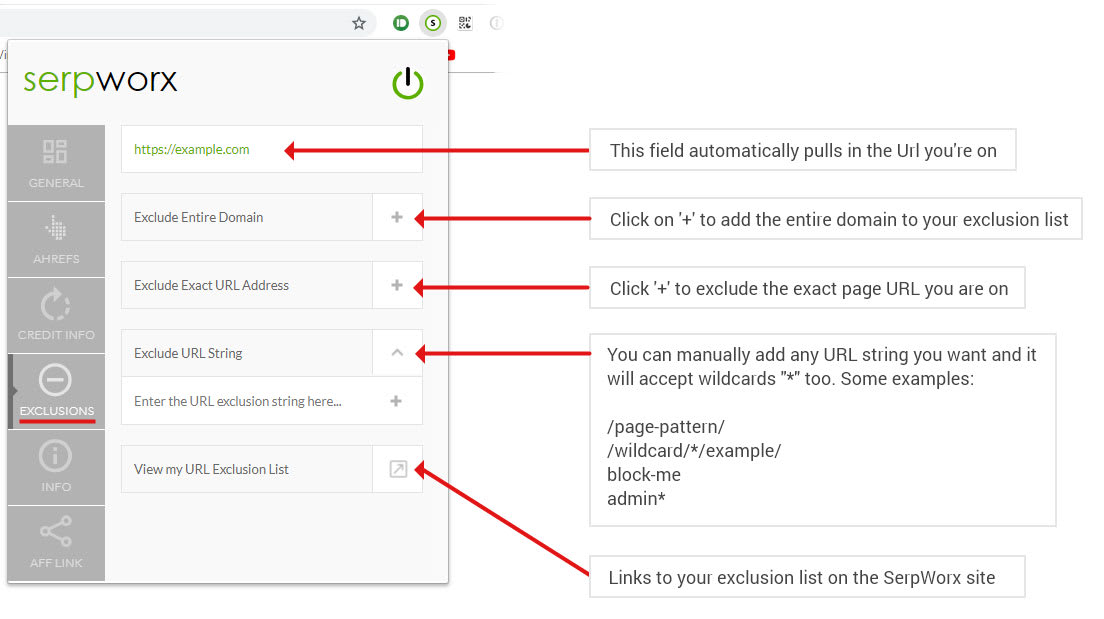
You can manually exclude any domain name, exact page address or URL string you want from within the SerpWorx settings. Here's a screenshot explaining what each setting does
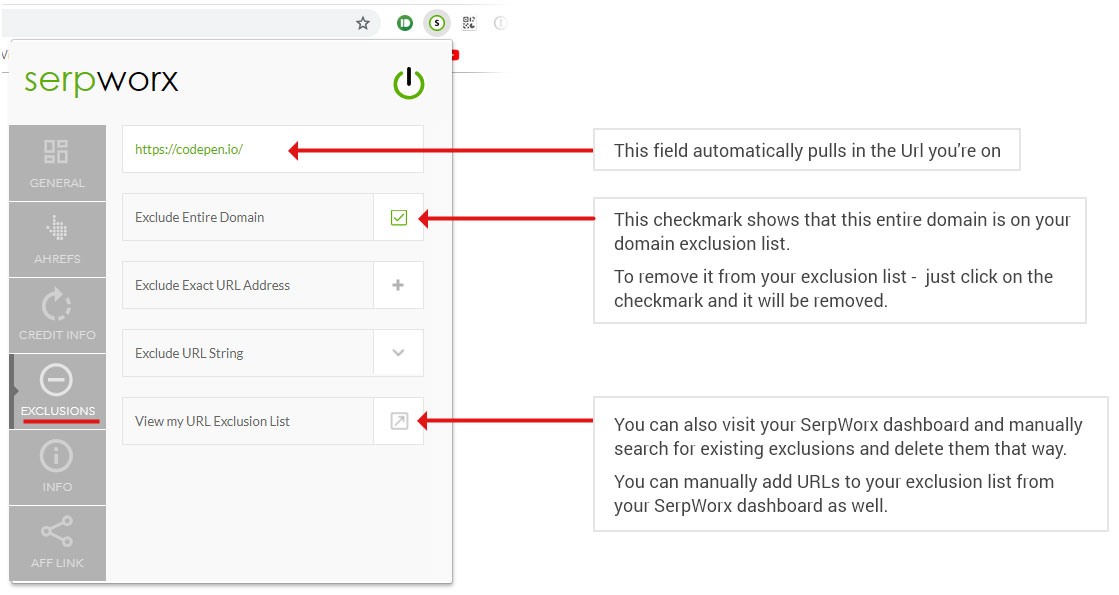
If you're on a webpage and the SerpWorx toolbar does not show - it means you have added it to your exclusion list. You can easily check this. Here's how to remove it from your exclusion list
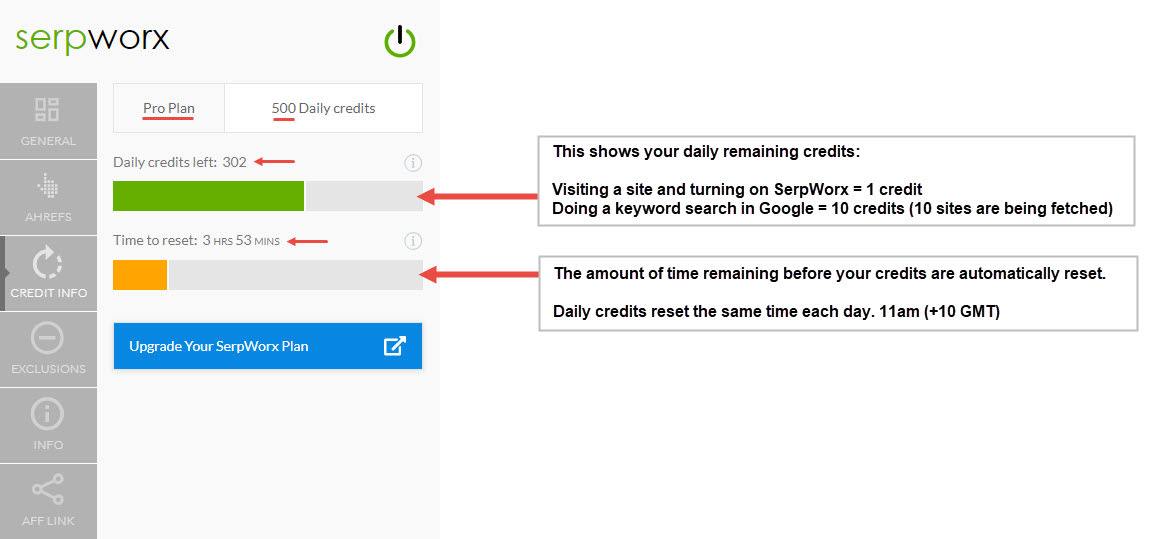
You can easily check your remaining credits from within the SerpWorx Extension settings as per this screenshot
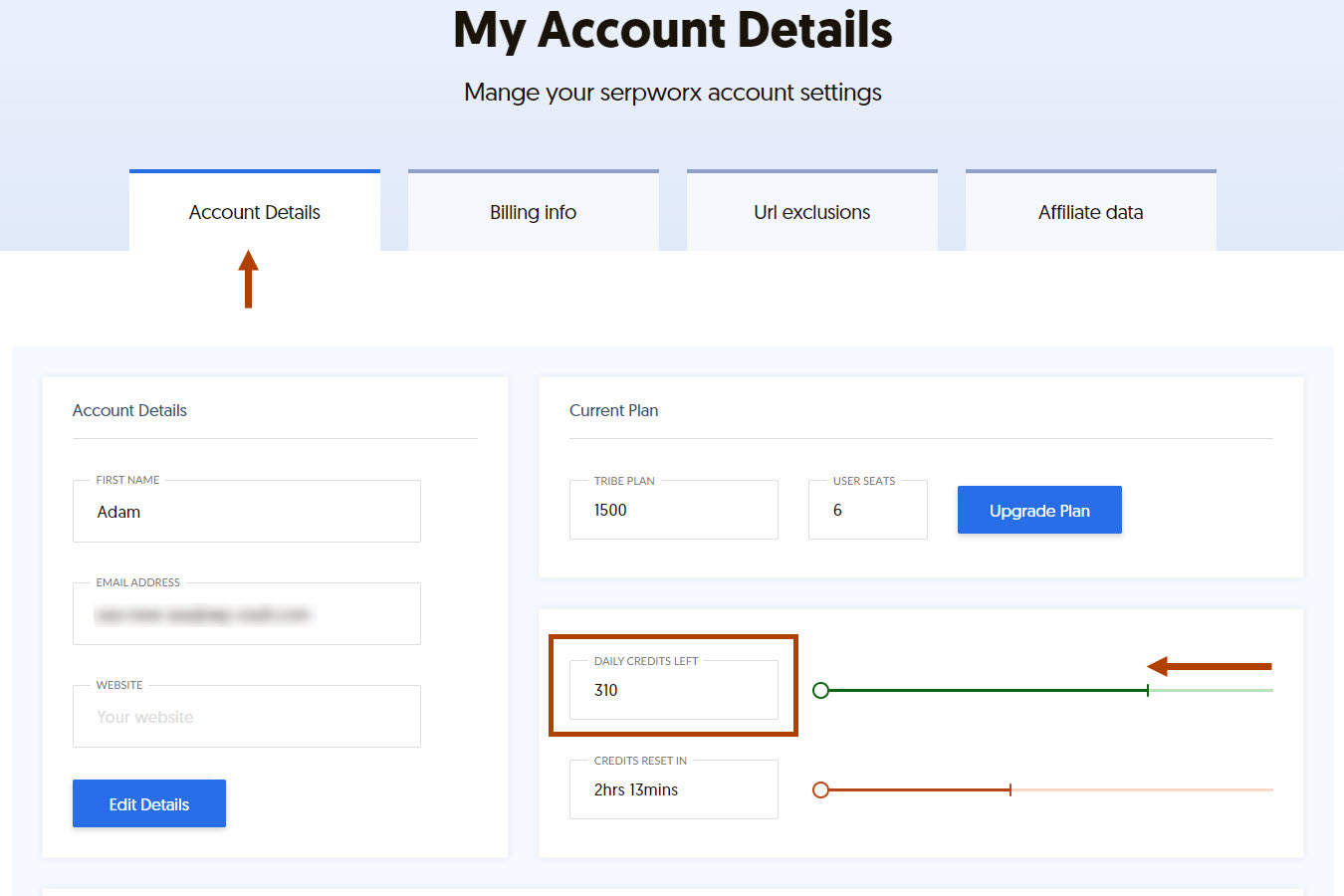
You can also use your account dashboard to check your remaining credits as per this screenshot
You can use the following link to reset your password: https://www.serpworx.com/forgot-password/
You can also reset your password from within the SerpWorx Chrome extension itself as per this screenshot
Word Count Questions
SerpWorx counts all the words between the opening <body> tag and closing </body> tag on the front facing webpage. The main purpose of the 'word count' feature is to show you how many words the front facing webpage has. It gives you an accurate 'word count' for each site in the SERPs' when searching for any keyword.
If you're comparing 'word count' metrics from other providers, be aware there are many possible 'word count' variables and how different scrapers may count the words. We don't count the following words:
- Words inside of image tags (alt='Not Counted' title='Not Counted')
- Words inside 'Meta title', 'Meta description' or 'Meta keyword' tags
- Words inside <a> tags: <a href='#' title='We don't count these'> But we do count these</a>
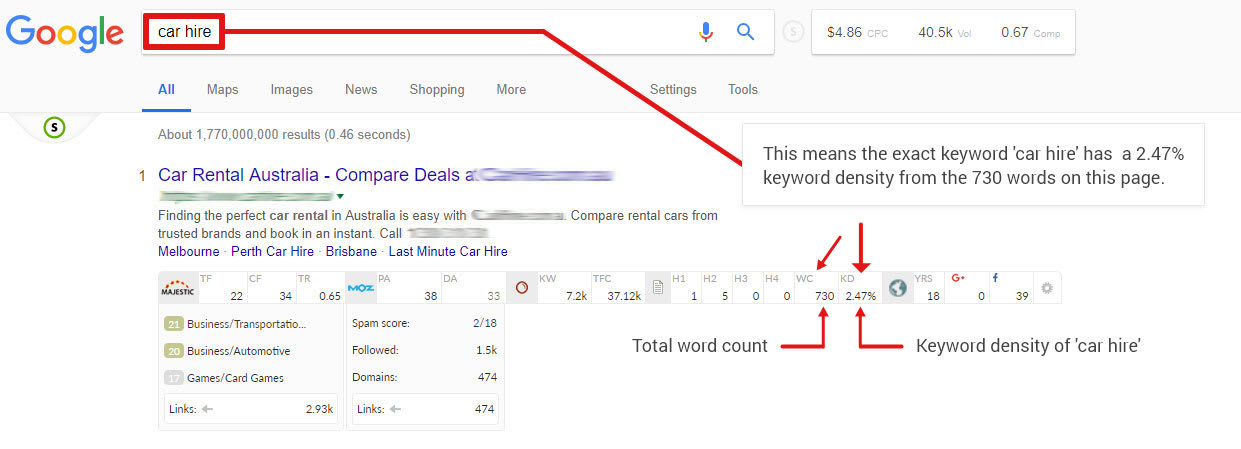
The best way to explain how the keyword density calculation works is by this screenshot here SerpWorx counts keyword instances between the body tags. Keywords inside meta title & description tags don't count towards the keyword density calculation.
As an example, if we counted keywords inside meta tags and alt tags etc, then you may see a keyword density of 2% for a webpage - but you wouldn't even be able to see that keyword on the webpage anywhere. This would confuse everyone which is why we don't count keywords inside meta title and description tags, image alt and title tags.
We based our calculation method strictly from the most widely recognised keyword density formula which can be found here: https://en.wikipedia.org/wiki/Keyword_density
Most SEO's want to know how many times a particular keyword is actually visible on the front facing page. It's like going on the page and using CTRL+F to see how many times you can find the keyword on that webpage. That's the keyword density result SerpWorx returns.
If you're comparing results between different keyword density tools there will always be conflicting results depending on what those services are counting before they make the final calculation. That's why you'll never get the same keyword density result from two different services.
For SerpWorx, we kept it simple by only counting the visible words you see on a webpage. We did this because we felt most users wanted to know what the keyword density was on the front facing webpage, and not count keywords hidden inside html attribute tags that a website visitor can't see.
When it comes to word count and keyword density, most SEO's want to know how many times a particular keyword is actually visible on the front facing page, and how many words are on the front facing page.
It's for this very reason that any words inside meta title and description tags, image alt and title tags don't count towards word count or keyword density.
If we counted keywords inside these tags then you may see a keyword density of 2% for a webpage - but you wouldn't be able to see that keyword anywhere on the front facing webpage. This would confuse everyone which is why we don't count keywords inside meta tags, alt tags and title tags.
Sometimes there appears to be an error in the word count - but there is not!
It says there's 2000 words but clearly there's not? - SerpWorx sees all the text, even when it's hidden with CSS. Be sure to look for text inside 'testimonial sliders' that may cycle through 20 different testimonials of 100 words each. Also be aware of hidden elements that only open upon clicking or hovering like FAQ's often do.
Our 'word count' technology is very powerful and accurate! It's capable of finding and counting all the words contained in these hidden elements like 'testimonial sliders' etc. Often people miss these elements on a page and assume the word count data is incorrect - but it is not!
When content is in a page's source code, Google counts it, and that's why we show it as contributing towards the word count as well. It doesn't matter if you can't see it on the front-end because it's hidden with CSS, Google still counts it and so does SerpWorx. (We cache 'word count' results for 24hrs)
SerpWorx Questions
Spam Score is a SerpWorx metric that estimates how spammy a website or page looks. It's shown as a percentage from 0% to 100% and the lower the score, the better.
Low 0-30%Medium 31-60%High 61-100%- 0-30% = Low - the site looks clean and trustworthy
- 31-60% = Medium - some spam signals are present, worth a closer look
- 61-100% = High - the site shows many of the classic signs of spam
How is Spam Score calculated?
Every page is checked against 18 simple signals. Trust signals pull the score down towards 0%, while spam flags push it up towards 100%. The more spam flags a page trips, the higher its final score:Pulls the score down (good)
- Uses the secure HTTPS protocol
- Shows real contact details
- Normal-length page titles & descriptions
- References trusted sources like Google, Bing, Facebook or Twitter
- Has social sharing meta tags
Pushes the score up (bad)
- Still running on insecure HTTP
- Numbers stuffed into the domain name
- A domain extension favoured by spammers (.xyz, .top, .icu etc)
- A very short or very long domain name
- 100's of external links crammed onto one page
- No contact info anywhere on the page
How is a whole domain scored?
SerpWorx scores each page individually and then takes the average. For example, if a site has 5 pages scoring 30%, 45%, 20%, 10% and 70%, then its domain Spam Score is (30 + 45 + 20 + 10 + 70) ÷ 5 = 35% - a medium score.Treat Spam Score as a quick health check rather than a final verdict. The odd legitimate site can trip a flag or two, but when you're reviewing your own backlinks or sizing up a competitor, a consistently high score is a clear signal to dig deeper before trusting that site.
Domain Rank is a SerpWorx metric that measures the overall strength of a website's backlink profile - in other words, how much authority a domain has earned from the links pointing to it. It's scored from 0 to 100 and the higher the score, the better.
0-1011-3031-6061-100- 0-10 = New - brand-new domains or sites with very few backlinks
- 11-30 = Growing - sites that are actively earning links and building momentum
- 31-60 = Established - well-known sites with a strong, healthy backlink profile
- 61-100 = Powerhouse - the internet's giants; very few domains ever reach this range
How is Domain Rank calculated?
Domain Rank is built on the same core principle as Google's original PageRank: every link is a vote of confidence, but not all votes are equal. Three things matter most:- How many pages link to the site
- How authoritative each of those linking pages is
- How many other links each linking page contains - a link from a page with 5 outbound links passes far more value than a link from a page with 500
Every page of a domain is scored first, and those page scores are then rolled up into one domain-wide score on a logarithmic scale. That means each extra point becomes progressively harder to earn - moving from 20 to 21 is easy, but climbing from 70 to 71 can take hundreds of quality links.
Links that pass rank (good)
- Standard dofollow links from authoritative pages
- Links from pages with only a handful of outbound links
- 301 redirects - these pass their full rank across
- Canonical links - these also pass their full rank
Links that pass little or nothing
- Links tagged nofollow - counted as backlinks, but pass no rank
- Links tagged sponsored or UGC - also counted, but pass no rank
- Links from pages stuffed with 100's of outbound links - the value is split between every link on the page, so each one passes only a sliver
The smartest way to use Domain Rank is as a comparison tool. Checking a site's score against the other sites ranking for your keyword instantly shows you who has the strongest link profile in that race - and because the scale is logarithmic, even a few points' difference between two competitors can represent a serious gap in link authority.
Page Rank is a SerpWorx metric that measures the authority of one specific page, based on the quality and quantity of the links pointing to that exact URL. Like Domain Rank it's scored from 0 to 100 and the higher the score, the better. The difference is scope: Domain Rank rates the strength of an entire website, while Page Rank rates the single page that's actually competing in the search results.
How is Page Rank calculated?
Page Rank is calculated with the same famous formula Google published when it first described PageRank - the algorithm that started modern search:PR(A) = (1 - d) + d × ( PR(T1)/C(T1) + ... + PR(Tn)/C(Tn) )- PR(A) - the Page Rank of page A, the page being scored
- T1 ... Tn - all of the pages that link to page A
- C(T) - the total number of links a linking page contains
- d - a damping factor, modelling the chance that a reader keeps clicking on links rather than stopping
In plain English: every page that links to you donates a slice of its own authority, and the size of that slice is the linking page's rank divided by the number of links it contains. A link from a page scoring 40 that contains 8 links passes a bigger slice (40 ÷ 8 = 5) than a link from a page scoring 90 that contains 90 links (90 ÷ 90 = 1).
Because every page's score depends on the scores of the pages linking to it, the calculation is run across the entire link index over and over until the numbers settle. That makes Page Rank a relative measure - your page's score reflects how it stacks up against every other page on the web, not just a raw count of its links.
Page Rank is at its most useful side-by-side with Domain Rank. A page with a modest Page Rank sitting on a huge Domain Rank is often ranking off the back of its domain's strength - which means a focused page with dedicated backlinks can absolutely outrank it.
Rank Passed shows you how much authority a backlink actually hands over to the site it points to. Two backlinks can look identical on the surface while one quietly delivers a serious rank boost and the other delivers nothing at all - Rank Passed is the metric that tells them apart.
How is Rank Passed calculated?
The starting point is the linking page's own Page Rank. That value is shared between every link on the page, so the fewer links a page contains, the bigger the share each one passes. From there, the type of link decides how much of that share actually gets through:301 redirect100%Canonical tag100%Dofollow linkits share302 redirectits shareNofollow, sponsored & UGC0%- 301 redirects & canonical tags - pass their full rank straight through to the destination
- Dofollow links & 302 redirects - pass the linking page's rank divided between every link on that page
- Nofollow, sponsored & UGC links - still counted as backlinks in your totals, but pass no rank at all
This is why a link from a huge site isn't automatically a jackpot. If your link sits on a page alongside hundreds of others, the authority is split so many ways that your slice may be tiny - while an editorial link from a modest blog with only a handful of links on the page can pass through far more.
Use Rank Passed to sort the genuine, needle-moving backlinks from the passengers. It's especially handy when auditing a link profile or weighing up a link opportunity - the question isn't how big is the site linking to me, it's how much rank does this specific link actually pass.
Majestic Question
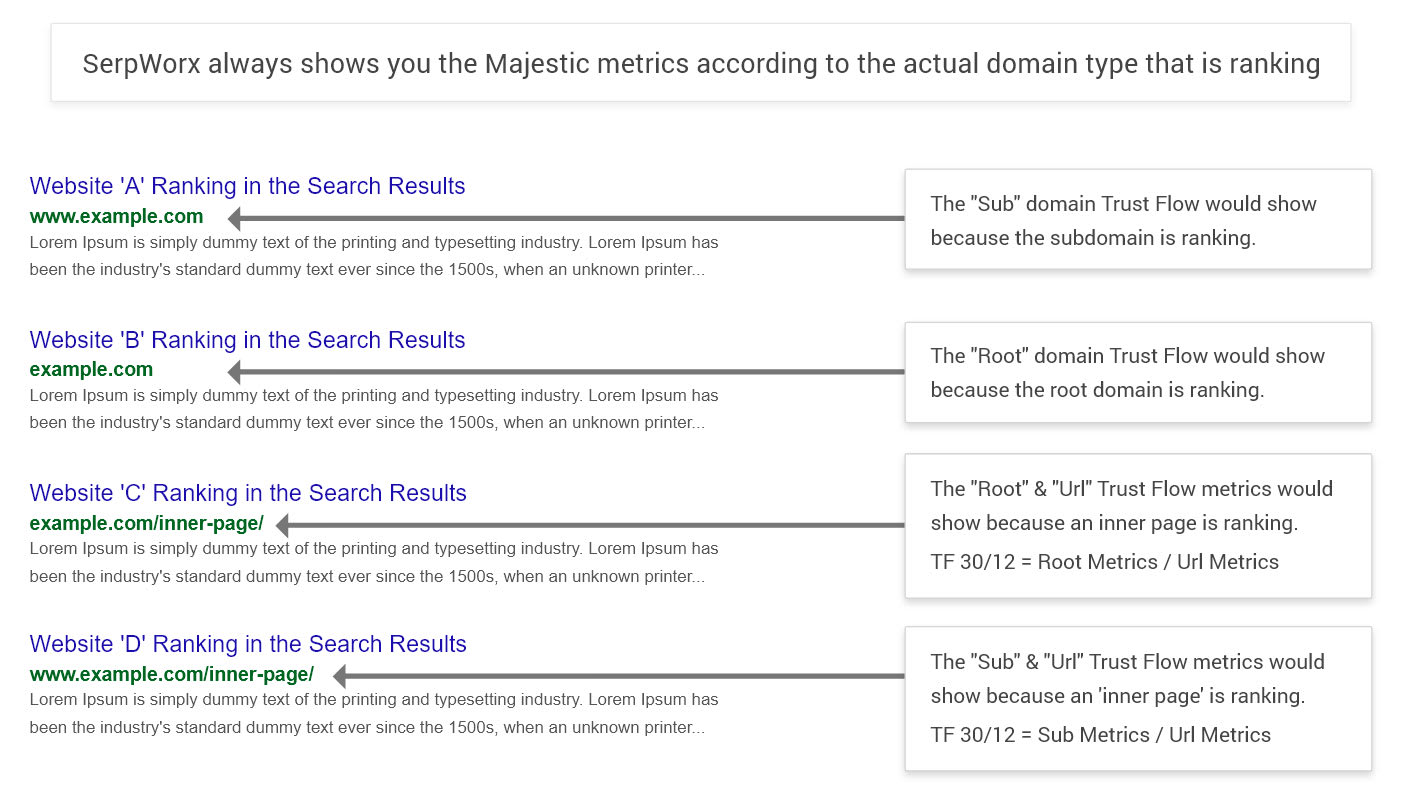
There are logic based rules that SerpWorx uses to show you the most accurate Majestic metrics. Whenever SerpWorx checks a domain it always shows you the metrics according to the domain type:
- https://example.com/ = fetches the 'root' domain results
- https://www.example.com/ = fetches the 'sub' domain results
- https://example.com/inner-page/ = fetches the 'Url' results
Here's a visual representation of which Majestic metrics are shown . SerpWorx always ensures that you're seeing the Majestic metrics according to the actual domain that is ranking in the search results.
(TF/CF = Trust Ratio)
The best possible Trust Ratio is 1. Trust Flow divided by Citation Flow = Trust Ratio.The best possible score in Majestic is a Trust Flow 100 and Citation Flow 100. Therefore, the best possible score for Trust Ratio is 1. TF100/CF100 = Trust Ratio 1 = the perfect score.
The closer the Trust Ratio to 1, the better. If your domain had a Trust Flow ratio of 1.3 (TF20 / CF15 = TR 1.3), it would mean that your domain has trustworthy links, but those links aren't bringing in much juice. That's because the sites your links are on don't have many inbound links either.
If your domain had a Trust Ratio of 0.7 (TF20 / CF28 = TR 0.7), it would mean that your domain has good link juice, but the sources of your inbound links may be questionable. It shows that the sites your links come from also have lots of inbound links, but it also show that their inbound links aren't that trustworthy either.
The Trust Ratio (TR) metric serves as another way to quantify the quality of your inbound links based solely on the Majestic Trust Flow and Citation Flow metrics. There's also a nice in-depth article about it on Majestic's blog here
The coloured squares in the Majestic part of the SerpWorx toolbar represent Majestic's Topical Trust Flow categories. A great article explaining how to understand Topical Trust Flow can be found on Majestic's blog here
The basic premise is that Majestic topically categorises all the inbound links going to a target website. It helps SEO practitioners to quickly gauge if a site's inbound links are coming from domains that are topically related to the target website.
No - you do not need a Majestic SEO account to use SerpWorx.
All Majestic SEO data is included with your SerpWorx subscription. All the data is shown within your SerpWorx toolbar without the need for any other subscriptions.
If you would like to learn more about Majestic or purchase a subscription then you can visit Majestic's pricing page here
Moz Questions
Currently the official Moz API does not provide Spam Score metrics as a percentage based calculation. The API only currently supports the previous Spam Score formatting which is a fractional-based format score:
- Spam Score is measured from 0 to 18 like so: 0/18
- 0/18 = the best possible Spam Score = the cleanest inbound links
- 18/18 = the worst possible Spam Score = very spammy inbound links
The current fractional based API formatting is still fetching results from the most up-to-date index. It's just that the format is represented as a fraction rather than a percentage. The Spam Score information is still current, live and accurate.
With the recent Moz link index upgrade, Spam Score has become more accurate than ever! It serves as an invaluable topline overview of how clean or dirty a given site's inbound links are.
Moz have done a phenomenal job with their most recent link index upgrade and their crawlers are finding more links than ever now! This in turn makes the Domain & Page Authority metrics even more reliable and accurate. There is a great video within this post explaining all the upgrades to the Moz link data - you can see the video here
Recently Moz have tightened up the restrictions on their free Link Explorer DA checks. Currently Moz only supports 10 Free queries per month with a free Moz account. And you cannot do any checks whatsoever unless you are logged into Moz.
You will notice that if you click on the Moz logo within SerpWorx, it no longer automatically shows you the Link Explorer data when you are redirected to the Moz page. This is because Moz have changed their account guidelines.
- You must now be logged in to see Moz's free Link Explorer data
- Every free Moz account is now limited to only 10 free DA checks per month
If you're logged into Moz, then you will automatically be correctly redirected to the Moz Link Explorer dashboard with the domain already loaded in for you when you click on the Moz logo within SerpWorx. However, if you're not logged into Moz, then clicking on the Moz logo would just redirect you to Link Explorer without showing you any results - because you're not logged in or you don't have a paid Moz account.
MozTrust and MozRank have been officially discontinued. The new Moz Link Explorer data has now completely replaced the old 'Open Site Explorer' link data.
The new Moz 'Link Explorer' has undergone a massive upgrade and the old SEO metrics MozTrust and MozRank have now been morphed into a much more accurate and powerful 'Page Authority' (PA) metric. Here's the the official Moz blog post here
No - you do not need a Moz account to use SerpWorx or see the Moz metrics or links.
All Moz data is included with your SerpWorx subscription. All of the data is shown within your SerpWorx toolbar without the need for any other subscriptions.
If you would like to learn more about Moz or purchase a subscription then you can visit the Moz pricing page here
Semrush Questions
The Semrush data you see in the search results depends on which version of Google you're searching from. For example:
- When using Google.com - you'll see US Semrush data
- When using Google.co.uk - you'll see UK Semrush data
- When using Google.com.au - you'll see AUS Semrush data
When you click on a site from the Google search results, SerpWorx shows you the Semrush data according to which country version Google you just came from. So if you're using Google.com and you click on a site that is a .co.uk domain - it will still show you the US traffic for that site because you came from Google.com
However, if you visit that same .co.uk site directly via a link or a bookmark etc, then SerpWorx will show you the UK data for that site because it's a .co.uk domain, and you visited it directly.
SerpWorx adjusts the Semrush country logic automatically for you and follows these basic logic rules:
- When visiting sites from the Google results: the country of the search engine will be shown
- When visiting a site directly: the country of the domain extension will be shown
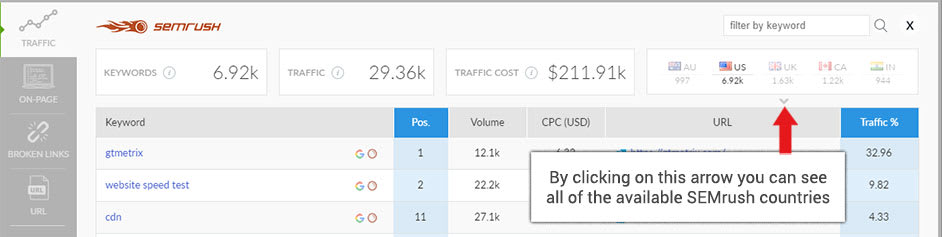
SerpWorx provides the Semrush data for 30 of the most popular countries. You can access more countries via the drop-down arrow, as per this screenshot
You can drag your favourite countries into the top section of the lightbox and they will stay there. SerpWorx will also automatically show you the data for the correct country should you visit a foreign website.
For example, if you visited a Spanish domain like https://www.archiexpo.es/ you will see that SerpWorx automatically shows you the Spanish traffic without you having to change any of the flags.
All Semrush data that you see is 100% live and accurate all the time. You just need to remember that SerpWorx adjusts the country logic for you automatically for you and follows these basic rules:
- When visiting sites from the Google results: the country of the search engine will be shown.
- When visiting a site directly: the country of the domain extension will be shown.
- When viewing sites in the search results - the country of the search engine will be shown.
If you're searching in google.com and you can see .co.uk sites in the results - you'll still see the US Semrush data for those .co.uk sites because you are searching in Google.com and not in Google.co.uk
The logic is - why would you want to see the UK traffic that a site is getting if you're searching from a US search engine (google.com). Obviously you are doing research on the US results using google.com so SerpWorx shows you the US traffic stats.
If you click through to a .co.uk site from the google.com search results, it will still show you the US traffic data because you just came from google.com. But when you open the SerpWorx lightbox on that site - you will then be able to also see the UK traffic data because it's a .co.uk site.
No - you do not need a Semrush account to use SerpWorx or see the Semrush data.
All Semrush data is included with a SerpWorx subscription. All the data in SerpWorx is shown without the need for any other subscriptions (*except ahrefs data).
If you would like to learn more about Semrush or purchase a subscription then you can visit the Semrush pricing page here
Page Authority Score (PAS) is Semrush's Authority Score measured for one specific page rather than the whole website. It grades the ranking strength of a single URL on a scale of 0 to 100 and the higher the score, the better. In the SerpWorx toolbar you see both scores side by side: AS rates the entire domain, while PAS rates the exact page that's actually ranking in front of you.
AS - Authority Score
- Grades the whole domain
- Judged against every other domain on the web
- Carries the site's entire backlink history - the good and the bad
PAS - Page Authority Score
- Grades one exact URL
- Judged against every other page on the web
- Counts only the links and traffic that page has earned itself
How is PAS calculated?
Semrush blends three ingredient groups into the score, and the same recipe applies whether it's grading a page or a whole domain:- Link strength - how many referring domains point at the page, and how authoritative those domains are
- Organic traffic - how many Google visitors the page attracts each month
- Profile naturalness - a series of spam checks hunting for manipulation, like link networks or a link count far larger than the traffic justifies
Why is PAS sometimes higher than AS?
This looks backwards at first, because metrics like ahrefs' DR & UR almost always show the domain above the page. Those metrics measure raw link mass, and a whole domain always holds at least as many links as any single page on it. Authority Score doesn't work that way - it's a quality grade, not a size measurement. The page is graded against the population of pages, the domain against the population of domains - two separately calibrated scales.So a clean, well-linked page on an average site will quite often out-score its own domain. The page's link profile can be tight and natural while the domain drags years of weaker links behind it - and because of the naturalness checks, more raw links can actually lower a domain's grade when they're out of balance with its traffic.
That gap is a genuinely useful signal when you're sizing up a SERP: a result whose PAS sits well above its AS is usually a strong page on a weaker site - exactly the kind of result that a focused page with quality, dedicated backlinks can overtake.
The Semrush ATD cell shows what share of a site's live backlinks use the keyword you just searched for as their anchor text. Exact match anchors are one of the strongest relevance signals in SEO, so seeing that share for every result tells you at a glance who has been building keyword-targeted links for your search term.
ATD = (keyword anchor links ÷ total backlinks) × 100- Keyword anchor links - every live backlink whose anchor text contains all the meaningful words of your search
- Total backlinks - the site's full live backlink count from Semrush
As an example: you search for kitchen renovations melbourne and a ranking site has 8,000 backlinks in total. Semrush finds 24 of those links using anchors that contain all three words - like 'kitchen renovations melbourne' or 'affordable kitchen renovations in melbourne'. 24 ÷ 8,000 × 100 = 0.3%.
A few details worth knowing:
- Filler words like 'in', 'the' and 'for' are ignored, and the meaningful words can appear in any order within the anchor
- Seeing 0% is completely normal - most pages rank without a single exact match anchor, so genuine scores usually sit well under 1%
- Hovering the ATD cell shows the running average across the whole page of results, so you can instantly spot who sits above or below the norm
SerpWorx calculates the SerpWorx and ahrefs ATD cells in exactly the same way, so you can compare all three providers apples for apples. If one shows 0% and another shows 0.5%, it simply means their crawlers have found different links - every index is measured with the same ruler.
Ahrefs Questions
Here's a quick video on how to connect your ahrefs account.
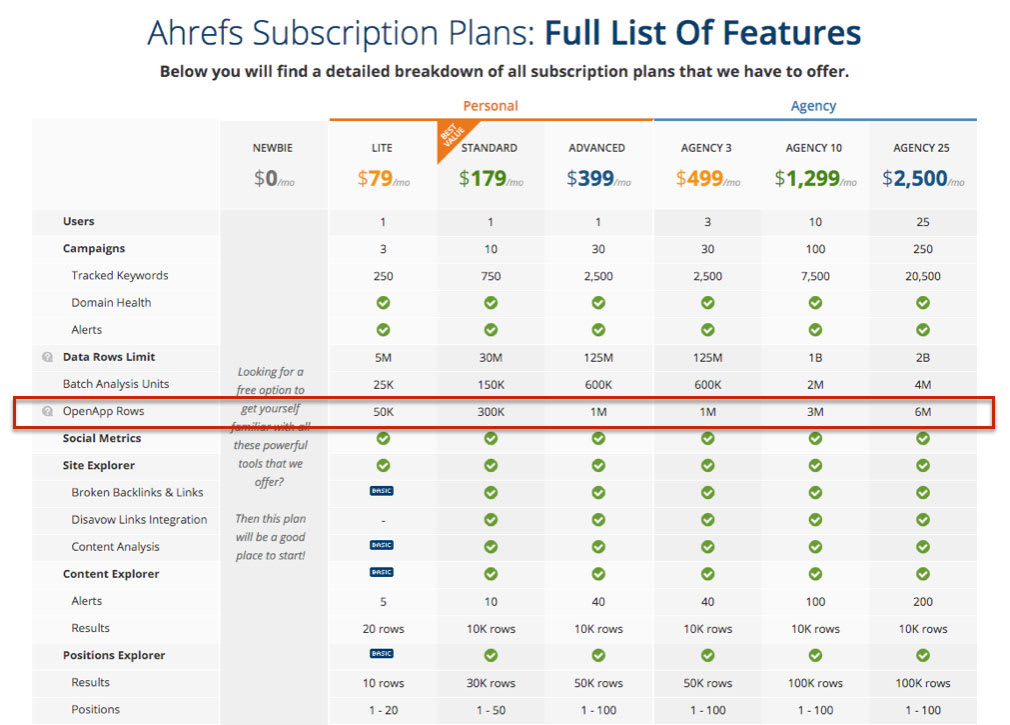
In this image here you can see the 'Open App Rows' highlighted in the red box. These are the ahrefs 'Open App Rows' you are using when you connect your ahrefs account to SerpWorx.
When you connect SerpWorx to your ahrefs account, no other ahrefs data is used except for your 'Open App Rows' (also known as - 'Integrations rows'). We do not collect any data, nor can we see any details associated with your ahrefs account.
You can easily check your remaining ahrefs 'Integration Rows' as per these quick video instructions
In this image here you can see the 'Open App Rows' highlighted in the red box. These are the ahrefs 'Open App Rows' you are using when you connect your ahrefs account to SerpWorx.
When you connect SerpWorx to your ahrefs account, no other ahrefs data is used except for your 'Open App Rows' (also known as - 'Integrations rows'). We do not collect any data, nor can we see any details associated with your ahrefs account.
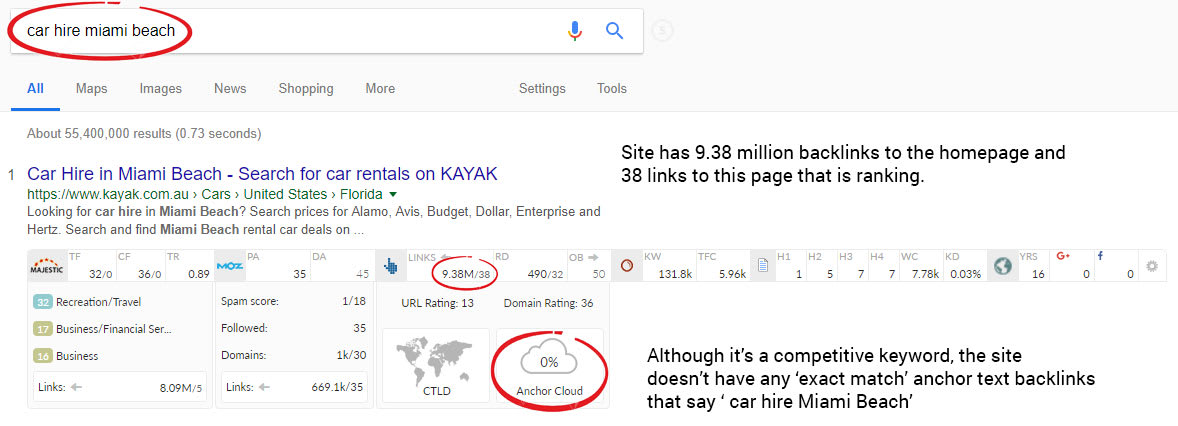
The keyword anchor cloud percentage is a percentage measurement of the keyword that you have just searched for - as per this screenshot
Exact match anchor text backlinks are very powerful in SEO and this is the reason that the toolbar displays the percentage results for the exact keyword that you've searched for.
Although a website may have 1000's of different anchor text backlinks, you may still see 0% within the toolbar. Like this example here This is because the exact keyword you searched for doesn't match any of the anchor text backlinks pointing to the site.
You don't have to have the ahrefs module enabled to use SerpWorx - but - if you want to display the ahrefs' information in the SerpWorx toolbar, then you'll need your own ahrefs account.
If you choose to sign up for an ahrefs account, or you already have one, then you can easily connect your ahrefs' account to SerpWorx in a couple of clicks as per the instructions in this short video